

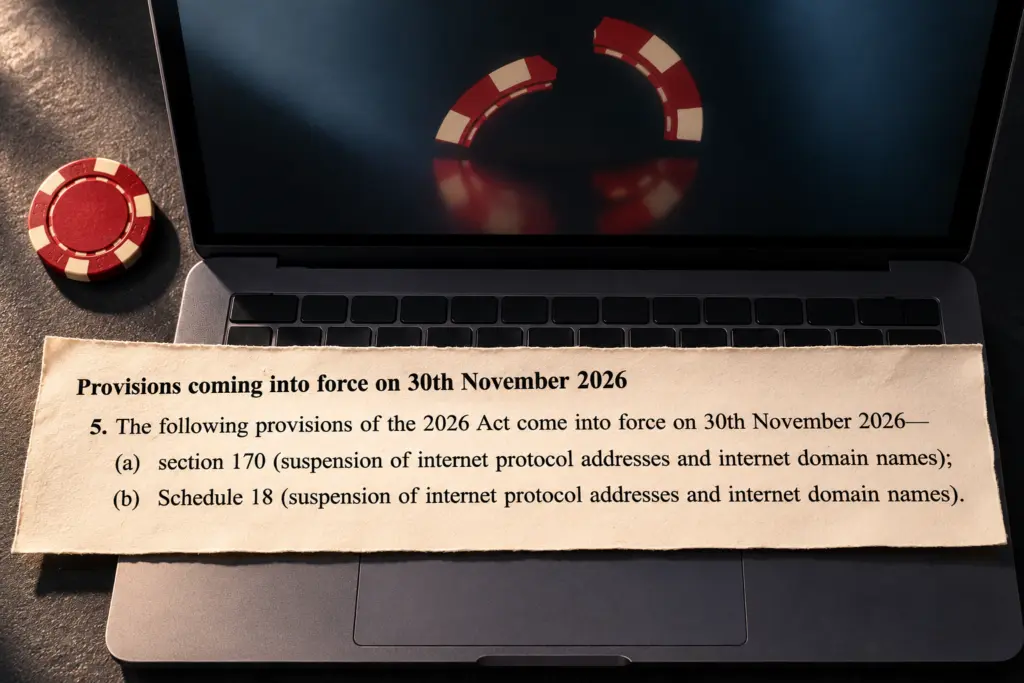
From 30 November 2026, new UK casino website blocking powers allow a judge to order a block on a casino website used for serious crime linked to unlicensed gambling. If you have money there, a block could cut off the withdrawal screen while a payout is pending. The order itself gives the court no power to confiscate or refund your balance.
If you have money in an unlicensed casino account
First, look up the exact website address in the Gambling Commission’s public register. Check the business name, its active licence and whether it can offer remote casino games. A logo in a footer can belong to a different operator. CasinoDrop’s guide to checking a casino’s domain against its licence shows how to spot a mismatch. The Commission requires an operating licence to serve players in Great Britain, even when the casino holds a licence overseas.
If the site still opens
If the operator lacks the licence it needs, stop depositing and request your available cash through its established withdrawal channel. Before closing the page, save a dated copy of the balance and account history. Include the web address and account ID so you can tie the records to the right site later.
Also save the request confirmation somewhere you control. If you have self-excluded, use support contact details you already know to ask for the balance. You can do that without returning to play. CasinoDrop’s responsible gambling guide explains how to keep your exclusion and bank gambling blocks in place.
If you have already asked for a payout
Keep the amount, the currency, the time you asked and the withdrawal reference. Then check the receiving bank account or wallet. An “approved” message on the site records what the operator told you. Your own statement records whether the money arrived.
If the payment is missing, ask the operator in writing for the date it sent the money and the payment reference. Save the reply alongside your original request. For example, a screenshot of the balance taken after a withdrawal request may show zero because the casino already deducted the amount. The earlier confirmation helps explain the difference.
If the website has gone offline
A browser error alone cannot tell you whether a judge made an order. Use an email address from an earlier receipt or support exchange to ask about the payment. If someone offers a replacement login or asks for another deposit to release your funds, keep the message and avoid sending more money. CasinoDrop’s guide to documenting a casino withdrawal dispute lists the records to keep.
For suspected unlicensed gambling, send the domain and supporting records to the Commission in confidence. The regulator uses reports to investigate. It says it lacks the powers to “resolve gambling complaints or help consumers get their money back”. If you suspect fraud, contact your bank or payment provider promptly. Use Report Fraud in England, Wales or Northern Ireland, or call Police Scotland on 101.
What a judge must establish before blocking a site
Section 170 introduces Schedule 18, which creates two kinds of order. For a domain name, the judge directs the named registry or registrar to prevent access to that web address. For an IP address, the order goes to the provider of that address. Either way, the order deals with access. It gives the provider no instruction to pay a customer, move money or close a casino account.
The judge needs reasonable grounds to believe four conditions hold. First, there must be serious criminal use. Second, the case needs one of the connections the Act specifies. For the gambling connection, the conduct must include the section 33 offence of providing gambling facilities unlawfully. It must also meet the separate test for serious crime. For example, conduct that results in substantial financial gain can meet that test.
Third, blocking access must be necessary and proportionate to prevent the criminal use. Finally, access would otherwise continue, or using another method would seriously hinder efforts to prevent or disrupt the crime. So a site’s offshore address or a promise of play outside GAMSTOP does not, by itself, meet the tests.
A court can serve the order overseas. The Home Office and Ministry of Justice say they expect most orders to go to providers abroad. They also expect voluntary cooperation with domestic providers to remain the first step.
Who can ask the court to act?
In England and Wales, the Gambling Commission can act through an enforcement officer it designates or appoints under section 303 of the Gambling Act. Under Schedule 18, the officer must either hold the required seniority or obtain a senior officer’s authorisation. For Commission staff, the senior grade starts at director. A Crown Court judge decides the application.
-
A designated Gambling Commission enforcement officer can apply with the required seniority or authorisation.
-
A Crown Court judge checks all four legal conditions and can grant or refuse the application.
-
If the judge grants the order, the named registry or registrar must block the specified domain.
How the process differs across the UK
Police, National Crime Agency, HM Revenue and Customs and Financial Conduct Authority officers can also apply in England and Wales. In Northern Ireland, the Act lists officers from those four bodies. A Crown Court judge hears the application there too. In Scotland, a procurator fiscal applies to a sheriff or summary sheriff. The Scottish court rules for these applications take effect on 7 December 2026.
How long can a block last?
Under Schedule 18, the first order can last up to 12 months. Before it expires, an officer can ask the judge for more time. The judge must consider again whether continued suspension is necessary and proportionate. Each extension can add up to 12 months, and an officer can apply again.
An officer may apply in private without advance notice. The judge can also restrict what the provider tells others. As a result, a player may lose access without time to download an account statement. Anyone affected can ask a judge to change or end the order. That procedure concerns the block itself.
What researchers saw when they tried to withdraw
In a study published online in Public Health on 16 November 2026, researchers followed social media adverts for casinos promoting play outside GAMSTOP. They identified ten unlicensed operators and deposited money at nine. By the time they wrote up the study, they had received no withdrawal money from any of those nine.
The researchers declined to send identity documents to unlicensed operators because of the privacy risk. One site marked its withdrawal approved, yet the payment never reached the researchers’ bank during the study. Their experience illustrates why it helps to keep both the operator’s response and your own payment records.
If you paid in crypto, keep the network, transaction ID and full wallet address from your receipt. Paste the address into CasinoDrop’s wallet checker to see whether it matches a known casino wallet. A match can help identify an address in your records. Only the operator can confirm what it credited to your account.
- The researchers selected operators through specific social media adverts. The results describe those sites only.
- The study took place before the court powers began, so it cannot tell us how a suspension affects payouts.
FAQs
Will all non-GAMSTOP casinos close on 30 November?
No. The regulations set the date when the court powers begin. Each order needs its own application, and the judge must assess the evidence for the particular address.
Does a block cancel a pending withdrawal?
The order directs a provider to prevent access to a web address. It does not decide whether the casino owes you money or whether the payment has gone through. Check your bank or wallet records and keep the withdrawal reference.
Is 30 November the last day to withdraw?
No. The regulations set no cash-out deadline. However, a judge can hear an application without notice, so keep copies of your account and payment records while you can reach them.
Will the Gambling Commission refund my balance?
The Commission cannot recover an individual balance. Contact the operator about your withdrawal. Separately, you can submit evidence of suspected unlicensed gambling through the Commission’s confidential reporting service.
Can a casino site stay blocked for more than a year?
Yes. The Act caps the initial order at 12 months. Before it expires, an officer can ask a judge for an extension. Each extension requires a fresh decision, and the Act allows more than one.
Bottom line
- Check the domain. Match the address and the licence in the public register before relying on what a site claims.
- Keep the payment trail. Save your balance, withdrawal reference and bank or wallet record where you can still reach them if the site goes offline.
- Report a suspected offence. The regulator can use your evidence even though the payout remains a separate matter.

Leave a comment