This Sugar Rush 1000 slot review has a simple reason to favour the familiar sweets: the bonus can build something. Winning positions develop multipliers, and free spins preserve that work instead of wiping the board after every spin. The higher ceiling is an upgrade to an established formula, but the underlying progression remains a good one. Our 7.5/10 score recognises that strength while leaving room for the repetitive base game and costly enhanced entry.
Key Facts at a Glance
- Studio: Pragmatic Play slot catalogue.
- Layout: 7×7, with clusters of five or more connected matching symbols.
- Position rules: winning explosions develop persistent cells during the bonus; ordinary base-game sequences reset.
- Released: 18 March 2024, according to the provider announcement.
- Configuration: the familiar 96.53% reference is not the only version; verified lower rules also exist.
Theme and Visuals
Gummy bears, a green star, a purple bean and oversized sweets sit in a bright candy landscape. The exact-game images show a large square board rather than the narrower scatter-pay arrangement of Sweet Bonanza. That difference matters visually: coloured positions beneath the sweets can explain where value has accumulated.
The artwork is friendly and recognisable, though it does not pretend to escape the established Sugar Rush vocabulary. The more useful distinction is functional. A board whose positions retain meaning can tell a little story across a bonus.
How to Play Sugar Rush 1000
- Check the in-game rules for the RTP of the actual build, then select the ordinary total bet.
- Look for five or more matching symbols connected horizontally or vertically. Diagonal contact alone does not count.
- Winning clusters are paid and removed; replacement sweets fall in and may create further clusters on the same paid spin.
- Watch the positions beneath winning symbols. Repeat winning explosions at the same cell build its multiplier.
- Three or more scatters trigger free spins. The bonus retains position progress between spins; a normal base sequence does not.
Use the free slot demo library to learn the difference between a connected cluster and a scatter-pay game before considering real-money play. A larger grid does not mean every visible group pays. Nor does a board with several high multipliers guarantee that the next symbols will form a cluster across them.
Symbols and Paytable
These selected awards cover clusters of five, ten and fifteen or more symbols. Intermediate sizes have their own awards in the full rules. Values below are multiples of the ordinary total bet before position multipliers, not coin counts or a separate line bet.
| Symbol | 5 symbols | 10 symbols | 15+ |
|---|---|---|---|
| Orange bear | 0.20× | 1× | 20× |
| Purple bear | 0.25× | 1.25× | 25× |
| Red bear | 0.30× | 1.5× | 30× |
| Green star | 0.40× | 2× | 40× |
| Purple bean | 0.50× | 3× | 60× |
| Orange heart | 0.75× | 4× | 100× |
| Pink round sweet | 1× | 5× | 150× |
At a 1-unit total bet, five orange bears return 0.20 units before multipliers. Ten pink round sweets pay 5 units, while fifteen or more pay 150. The small starting awards explain why a winning cluster can still leave the paid spin below its cost. The appeal lies in extending the tumble and involving developed positions, rather than treating every cluster as a substantial result.
A large cluster and a well-developed board are different ingredients. A premium cluster can pay well before multipliers; a modest cluster can become more valuable if it covers the right positions. Neither condition establishes how often the other will arrive.
Slot Features
Clusters and cascading wins
All symbols in a winning cluster disappear, making room for another result. The process continues while fresh clusters qualify. This lets a single paid spin develop through several stages, and gives the multiplier positions repeated opportunities to become relevant.
The connection rule also makes Sugar Rush more spatial than a pay-anywhere slot. Identical sweets separated across the board are not automatically useful. That is a meaningful part of its design, even though the player cannot choose where replacements fall.
Multiplier positions
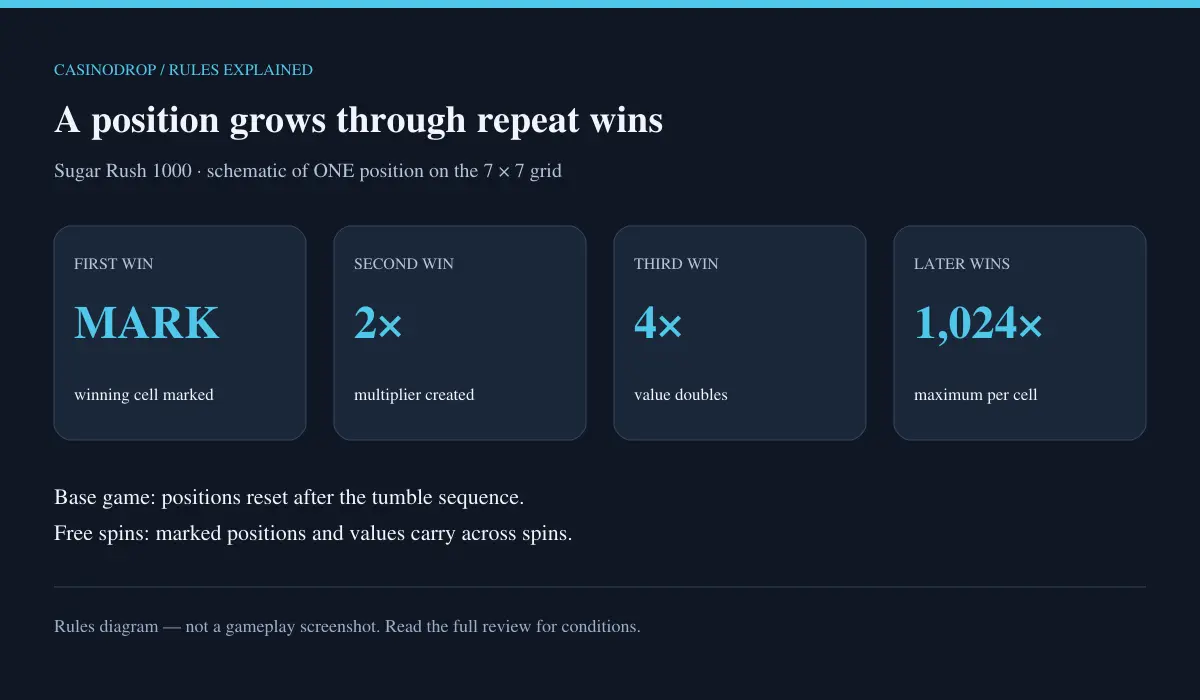
The first winning explosion marks a position. A second winning explosion at that same cell creates a 2× multiplier. Further winning explosions double its value through powers of two, up to 1,024×. The exact limit is therefore 1,024×, not the rounded 1000 used in the title.
If a cluster uses more than one multiplier position, the qualifying values add together. They do not multiply each other. A cluster crossing 2× and 4× positions uses a combined 6× value; it does not receive 8×. This is worth understanding before a busy board makes the arithmetic look more generous than it is.
In ordinary play, the progress belongs to the current tumble sequence and resets afterwards. That gives an extended sequence direction, but also limits how much the base game can build over time. A promising-looking arrangement does not carry into the next independently paid spin.
Slot Bonus Features
Free spins
| Scatters | Spins awarded |
|---|---|
| 3 | 10 |
| 4 | 12 |
| 5 | 15 |
| 6 | 20 |
| 7 | 30 |
The same scatter-count schedule applies to retriggers during free spins. More entry scatters therefore change the initial number of opportunities rather than merely adding a decorative flourish to the trigger.
The important change is persistence: marked positions and multipliers remain across the feature. Earlier winning clusters can leave useful cells for later spins. Retriggers can extend that opportunity further. This is the strongest design element because the bonus has a memory, although that memory still needs subsequent clusters to use it.
Super Free Spins
The enhanced feature begins with all 49 positions already carrying 2× multipliers. That removes the ordinary need to mark a cell and then win there again before a multiplier exists. It is a recognisable change to the starting board, not merely a promise that the bonus might be better.
It does not start every cell at the ceiling, and it does not guarantee a large cluster or a positive result. The player is paying for a stronger initial configuration within the same random system. The ordinary feature can still be engaging precisely because its development is visible.
Bonus Buy Options
Ordinary free spins cost 100× the base bet, while Super Free Spins cost 500×. Purchased entries use a random three to seven scatters according to the documented rules. At a 1-unit base bet, those prices are 100 and 500 units; they are not ordinary 1-unit spins with an optional visual effect.
The directly available YesPlay rules describe the lower 95.50% build. In that configuration, the purchase RTPs are 95.51% and 95.43% respectively. Their long-run expected losses per purchase are therefore 4.49 and 22.85 base-bet units. These figures must not be silently attached to the separate 96.53% reference version. Availability and purchase controls vary by operator and jurisdiction.
How to Max Win on Sugar Rush 1000
The overall round limit is 25,000× the ordinary bet. Growing positions and larger clusters can combine towards that total, but a 1,024× cell is not a cash award by itself. It needs to participate in a qualifying win, and all resulting awards remain subject to the round cap.
Typical Max Win Sequence: a possible route is a free-spins feature that repeatedly develops positions, then places substantial winning clusters across those positions until the cumulative payout reaches 25,000×. Reaching the cap ends the round. This is an explanation of a permitted route, not a measured typical outcome, a guaranteed sequence or a recorded win.
RTP and Volatility
The reference RTP is 96.53%, corroborated by an operator rules compilation. The directly downloadable YesPlay document instead specifies 95.50%, and a Betfair listing discloses 94.50%. The game name and artwork alone do not identify which setting is active.
Over 100 units of turnover, those percentages imply theoretical costs of 3.47, 4.50 and 5.50 units. Moving from 96.53% to 94.50% adds 2.03 units of expected loss per 100 wagered. These are long-run calculations; they do not tell you what a particular balance will do or how long it will last.
The rules classify volatility as High. Small initial cluster awards, resets in the base game and potentially powerful accumulated positions suggest a pronounced difference between ordinary outcomes and developed bonuses. That is an inference from the mechanics, not a measured session. The Stake measured-RTP tracker records observed sample returns separately; those observations should not be confused with the theoretical setting in a game’s help screen.
Pros and Cons
Pros
- Position growth gives the bonus a clear sense of progression.
- Persistent cells make earlier bonus wins relevant to later spins.
- Cluster rules reward connected arrangements rather than arbitrary paylines.
- The enhanced feature has a concrete, understandable starting advantage.
- Exact position limits and lower RTP settings can be documented.
Cons
- The base game discards progress after each tumble sequence.
- Small clusters often pay below the ordinary spin cost before multipliers.
- The presentation and core formula remain familiar.
- A 500× purchase exposes a substantial amount to one feature.
- Lower operator settings can increase theoretical cost materially.
Conclusion
Sugar Rush 1000 earns 7.5/10. Building multiplier positions gives the free spins a visible sense of progress: earlier wins can make later connections matter more. That is the strongest part of the original formula, and it survives the upgrade. The larger ceiling adds scope, even if another numbered candy sequel is hardly a creative emergency.
It is a solid choice for players who like following a developing board and understanding why a later cluster pays more. The large grid, repeated candy imagery and dependence on useful connections will be less appealing to anyone seeking a brisk line slot. Persistent multipliers improve the structure of the bonus; they do not ensure that the symbols will cooperate before the spins run out. Compare other designs in the CasinoDrop slot catalogue. This assessment uses published rules and artwork; no hands-on session was completed.
FAQs
What is the RTP of Sugar Rush 1000?
The reference return is 96.53%. Verified lower disclosures include 95.50% and 94.50%. The YesPlay 95.50% rules separately list 95.51% for ordinary purchased free spins and 95.43% for Super Free Spins.
Is the highest position multiplier 1,000×?
No. Positions double through powers of two, so their documented maximum is 1,024×. The 1000 in the title is not the precise cell-multiplier limit.
How do multiplier spots develop?
The first winning explosion marks a position. A second at that position creates a 2× multiplier. Further winning explosions double it, up to 1,024×. Multiple qualifying position values in a cluster add together.
Do multiplier spots carry between ordinary spins?
No. They last through the current base-game tumble sequence and then reset. In free spins, the marked positions and multipliers remain for the feature.
How do you trigger free spins?
Three, four, five, six or seven scatters award 10, 12, 15, 20 or 30 free spins respectively. The same scatter-count schedule awards additional spins during the bonus.
How much does the bonus buy cost?
Ordinary free spins cost 100× the base bet. Super Free Spins cost 500× and begin with all 49 positions at 2×. Availability depends on the operator and jurisdiction.
What is the maximum win?
Sugar Rush 1000 has a 25,000× round cap. Reaching the cap ends the round; a high cell multiplier is not itself a guaranteed payout.
Are diagonal matches part of a cluster?
No. At least five matching symbols must connect horizontally or vertically. Diagonal contact alone does not make a winning cluster.